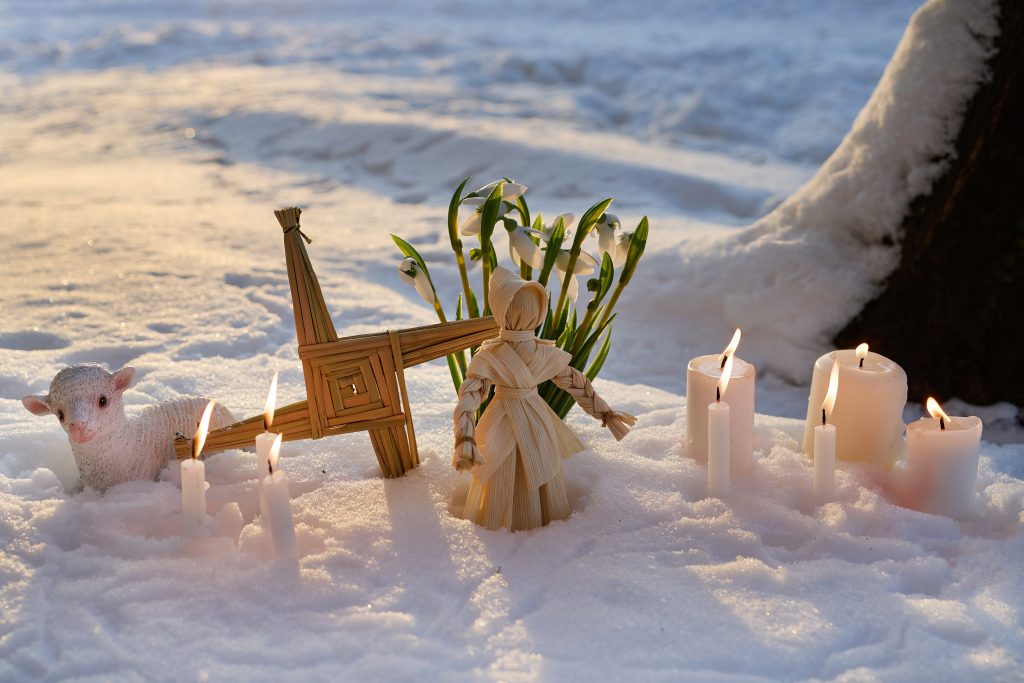
One of the four fire festivals on the wheel of the year, Imbolc sits between the winter solstice and spring equinox and is usually held on February 1st. Although it feels as though we are still in the depths of winter, Imbolc celebrates the stirring of new life beneath the surface and the very first signs of spring.
Imbolc is an ancient Celtic pagan festival and the word is likely derived from old Irish for ‘in the belly’, referring to the pregnancy of ewes at this time of year.
In what is probably a Christianisation of the pagan goddess Brigid, Christians also celebrate Imbolc as Saint Brigid’s Day, particularly in Ireland. Both the goddess Brigid and Saint Brigid share many associations, such as controlling the weather and the arrival of spring.
In Celtic lore, the powerful hag and Queen of winter – the Cailleach – gathers her firewood at Imbolc for the rest of winter. If the weather on Imbolc is fine and sunny, the winter will last for longer, because the Cailleach is able to gather plenty of wood. If the weather is bad, the Cailleach will sleep and winter is almost over. She passes the torch to Brigid so that spring may begin.
An echo of this story can be seen in the US and Canadian tradition of Groundhog Day (February 2nd). If the groundhog emerges from its burrow and sees its shadow, it will retreat into its den and winter will continue for another six weeks. If it sees no shadow, spring is on its way.
Similarly, we see the same allegory in Greek myth, where Imbolc marks the end of the ‘Persephone period’ when Persephone returns from the Underworld to the land of the living and the earth reawakens.
A really lovely time to set intentions for the coming year and focus on new creative projects and adventures. As the light returns to our days and nature reawakens, we can begin to emerge from our own winter hibernation and look to future endeavours.
Altar ideas:
Candles of white, pale blue/green and yellow. Crystals such as clear quartz, ruby, garnet, amethyst and adventurine. Daffodils, snowdrops and crocuses. Root vegetables like carrots, beetroot and onions. Milk, bread and seeds. Representations of lambs/sheep and calves/cows.